Give every layer a job
Place the moon at the back, the hills in the middle and a few trees at the front. Try the arrangement with loose paper before attaching it.
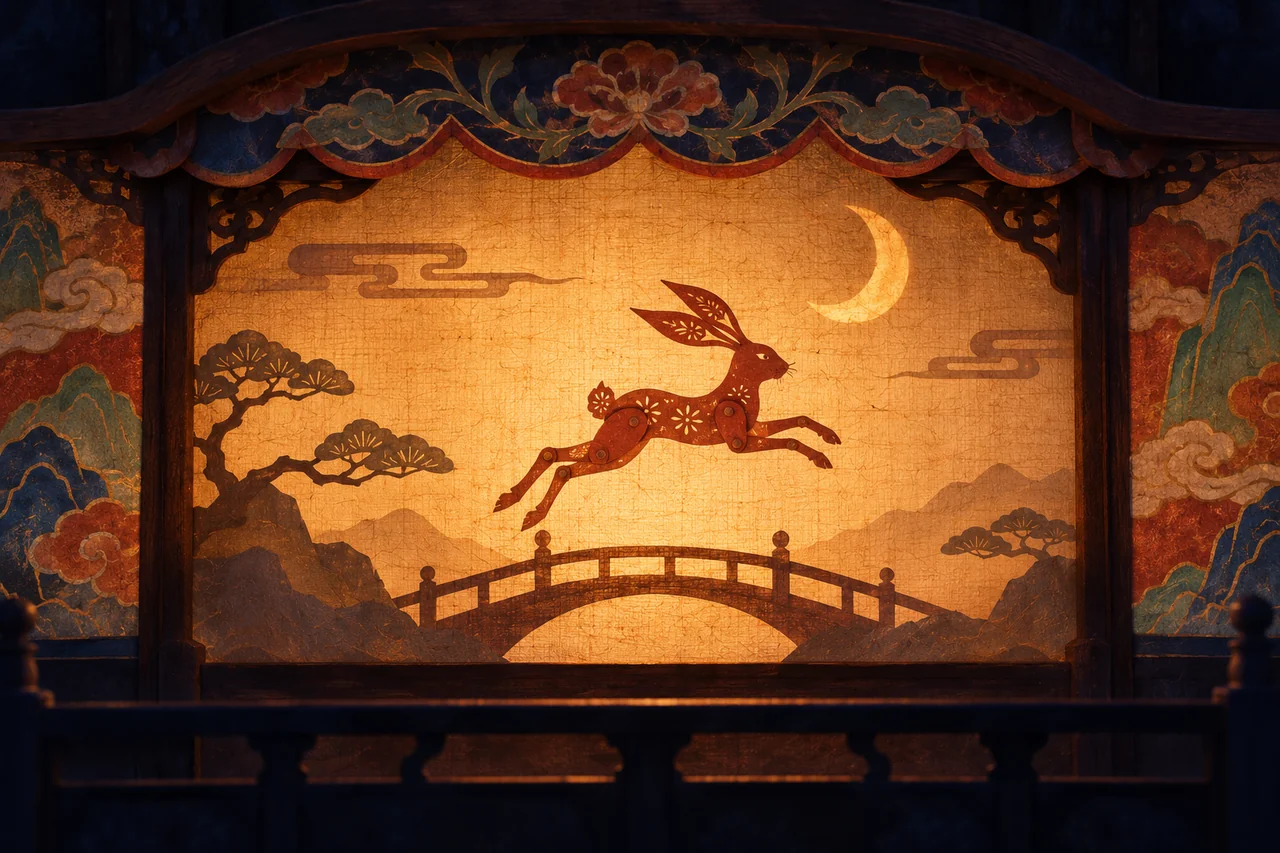
A paper hare. A lantern glow. Step behind the screen and see how light turns a cut shape into a character.
Unfold the paper worldIn Chinese shadow puppetry, performers move leather or paper figures with rods behind a lit, translucent screen. Music and song can accompany the performance. UNESCO added the tradition to its Representative List in 2011.
Read about the tradition at UNESCO ↗Lift the scenery to reveal the moon, hills and woodland around the hare. Each layer gives a flat silhouette a little more space.
The same digital hare appears in both panels, at the same size and angle. Look for the two ears, the rounded back and the small tail before looking at its surface detail.
Original digital diagrams using the same hare shape as the light study. Actual shadow edges depend on your light, paper and screen.
Ears Keep space between their tips so both can be read.
Body and tail Read the broad curved outline at a small size.
Control rod A line from below shows where a handle could meet the paper shape.
Keep the lamp and screen fixed. Move the same puppet and compare the size of its shadow.
Read how Chinese shadow puppetry worksA lifted ear and a long back leg help the hare read in silhouette. The scenery frames that gesture while leaving room for it to move.
Place the moon at the back, the hills in the middle and a few trees at the front. Try the arrangement with loose paper before attaching it.
Hold a cut shape against a plain light background. Simplify details that disappear at that scale, then add a few openings for texture.
A pop-up scene and a shadow screen use light differently. Make a small test with your own paper and cool LED light to see how each surface behaves.
Gather cardstock, scissors, tape, a paper straw, tracing paper and a cool LED flashlight.
Draw a hare or a bird with a clear outer edge. Cut the outline and tape the paper straw to its back.
Tape tracing paper across a cardboard frame. Set the flashlight behind the frame and hold the puppet between lamp and screen.
Try one slow turn and one quick leap. Watch from the front and see which motion reads clearly.
Use a cool LED light and keep paper clear of its housing. An adult should handle sharp tools for younger makers.
The hare, bridge and moon form an original Madefield illustration generated with Codex. The interactive scenery is a digital interpretation of layered paper. The paper-puppet activity is a simple way to explore silhouettes at home.
For the history and performance tradition, visit UNESCO’s Chinese shadow puppetry entry. Explore more paper crafts at Madefield House.